
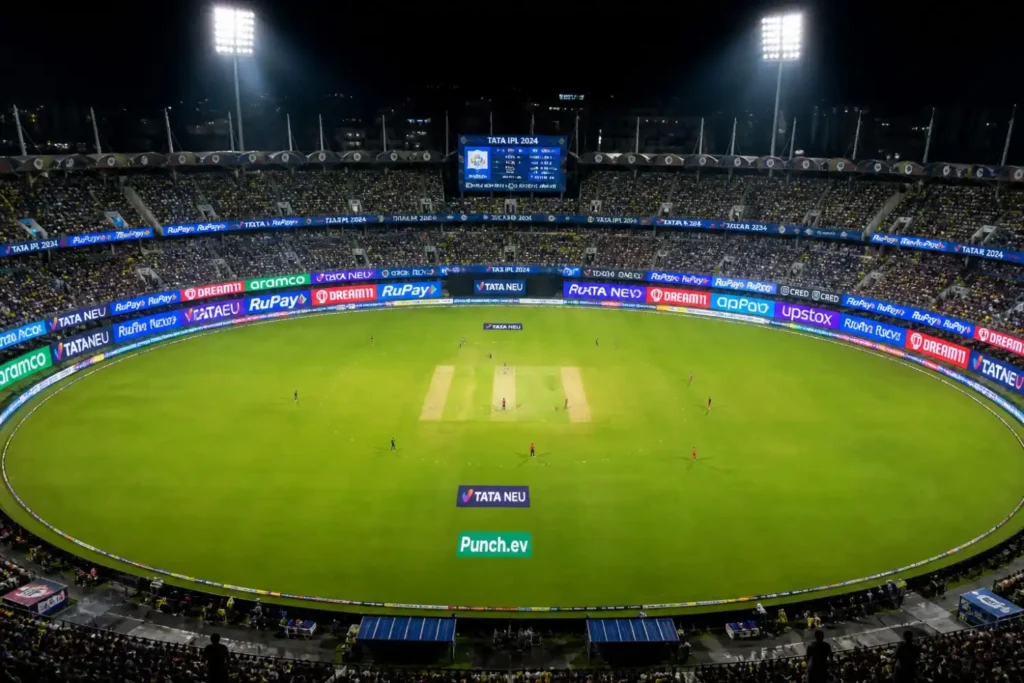
Think about the last time you watched a big game like IPL, the FIFA World Cup, the Premier League, or the Super Bowl. Now think about the ads you saw. Chances are, you remember at least one of them more clearly than you remember the half-time score. That’s not a coincidence. That’s psychology behind sports advertising at work.
Sports advertising is not just about reaching a large audience. It’s about reaching a specific kind of audience – one that is emotionally charged, deeply loyal, and wide open to influence. As someone who works as an integrated marketing consultant, I find sports events fascinating. Not as a fan, but as a case study in how human psychology and smart channel strategy come together to make people feel, remember, and buy.
Let me walk you through what’s really happening inside the mind of the fan and across every channel a brand touches.
The fan’s mind is already wide open
Here’s something that most people outside marketing don’t fully appreciate.
When someone sits down to watch a cricket match or a football final, they’re not in “ad-avoidance mode.” They’re in emotional mode. Their team just scored. Their heart is racing. Their guard is completely down.
Sports psychologist Daniel Wann puts it well – Fans are psychologically connected to their teams in a way that goes far deeper than any brand loyalty ever could. That connection serves a very human need: belonging, identity, and the thrill of feeling part of something bigger than yourself.
And when a brand shows up in that emotional moment consistently, smartly, across multiple touchpoints it doesn’t feel like an interruption. It feels like a part of the experience.
That’s the first big insight: sports advertising works because it borrows emotional energy that brands could never generate on their own. Now, how do the smart brands actually deploy this across channels? Let me break it down the psychology behind sports advertising .
Television: The emotional anchor of sports advertising
Let’s start with the obvious one.
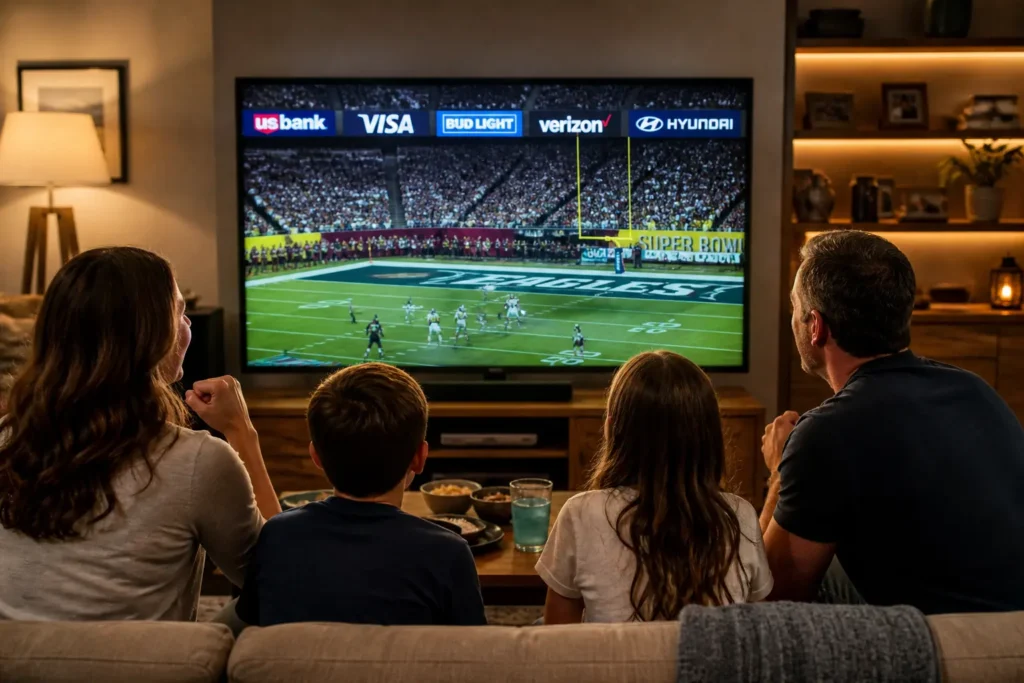
Linear TV during a live sports event is still the single most powerful way to build mass brand awareness in one shot. Super Bowl LIX drew over 127 million viewers. The FIFA World Cup 2026 is already being called the most-watched sporting event in history. IPL reaches over a billion impressions across its 84 matches.
No other medium hands you that kind of concentrated attention.
But TV during sports works differently from regular TV. Viewers are leaning forward, not backward. They’re emotionally present. This is why a well crafted 30-second spot during a tournament final can do in one airing what a regular campaign takes months to achieve.
The psychological trigger here is association. Your brand appears repeatedly alongside moments of joy, tension, and celebration. Over time, the brain starts linking your brand to those feelings almost automatically.
The smart play: keep messaging simple, keep it emotional, and show up consistently. One brilliant ad in one match is a spark. The same emotional message delivered across an entire season is a brand.
CTV and OTT: Where sports advertising meets precision targeting
Here’s where things get interesting for marketers.
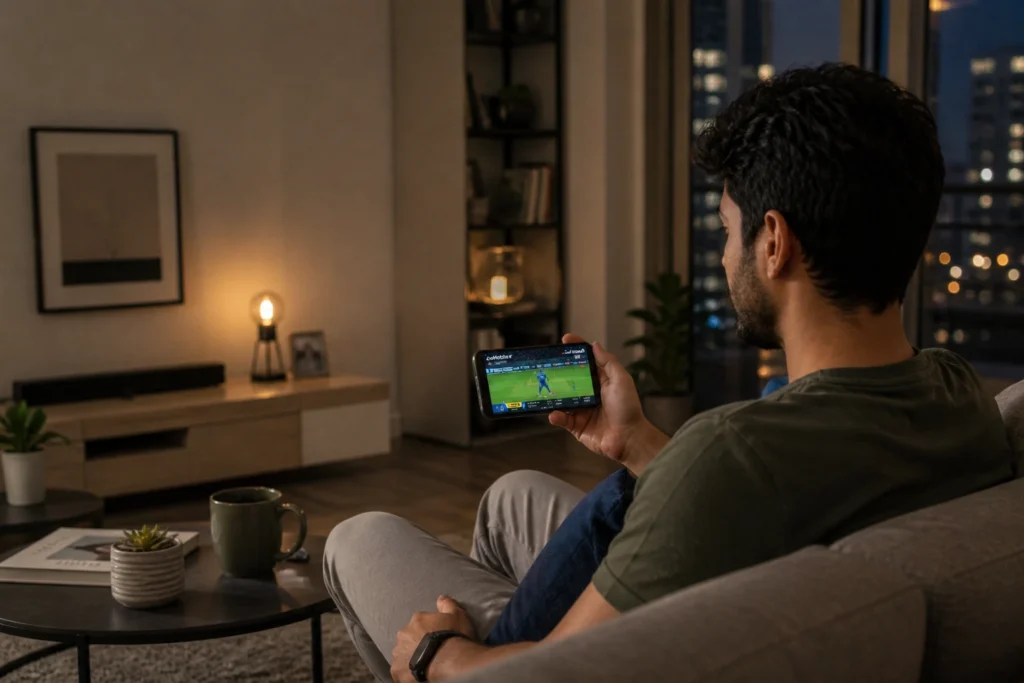
Connected TV (CTV) and OTT platforms- Think JioHotstar, Amazon Prime Video, Peacock, ESPN+ are rewriting the rules of sports advertising. And 2026 is the year it’s officially gone mainstream.
Nielsen reported that streaming hit 44.8% of total TV viewing in 2025 which overtaking broadcast and cable combined for the first time. During major sports events, that number spikes even higher. 73% of viewers now prefer watching sports on a big screen through a streaming device.
What makes CTV powerful isn’t just reach. It’s the combination of big-screen emotional impact with digital-level precision targeting. You get the storytelling power of TV, with the data intelligence of digital. CTV ad rates during sports are up 25% this season and still, many brands are underestimating it.
The psychological principle at play here is frequency with relevance. CTV lets you find the right fan based on their team loyalty, viewing habits, even purchase intent and deliver your message at the exact moment they’re most engaged. That’s not mass advertising. That’s precision emotion.
Pro tip as an Integrated Marketing practitioner: Don’t treat CTV as a standalone channel. It performs best when connected to your broader campaign – reinforcing what the fan just saw on linear TV, or warming them up before a social media retargeting sequence kicks in.
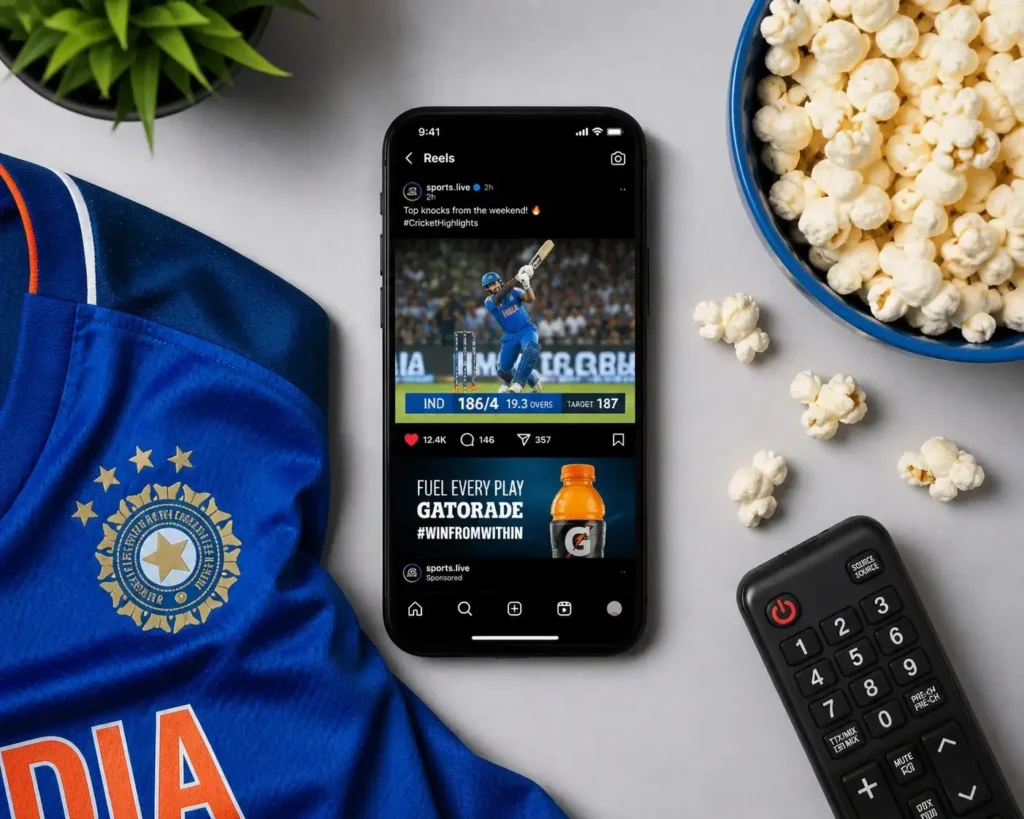
If TV is where fans watch the game, social media is where they live in it.
Every dropped catch, every stunning goal, every last-over thriller it’s being dissected, meme, argued over, and shared in real time across Instagram, X (Twitter), and even in YouTube. And brands that know how to plug into these moments win something TV never could. Organic participation.
In 2026, the smartest brands have pre-approved creative workflows that can pull live match data, build a finished visual, and push it live across platforms in under a minute. A brand that reacts to a toss result in 60 seconds isn’t being clever. It’s being culturally relevant which is the closest thing to invisible advertising that exists.
The psychology here is social proof and shared identity. When a brand shows up in the language of the fan – the memes, the slang, the inside jokes… it stops being an outsider trying to sell something and starts feeling like part of the community.
Key channel tactics:
- Pre-match hype content (polls, predictions, countdowns)
- Real-time reactive posts during the game
- Post-match recap content which, data shows, gets 50% of total creator engagement
That last point is gold. Most brands pour everything into the live window and vanish after the final whistle. The post-match conversation is where fans are most reflective, most talkative, and most open to brand messages that feel earned.
Influencer and creator marketing: The trust transfer in sports advertising
Here’s a number that should make every marketer pay attention.
IPL influencer spends are projected to hit ₹700 crore in 2026 up from ₹250 crore just three years ago. That’s not a trend. That’s a structural shift in how sports advertising works.
Why are brands betting so heavily on creators? Because of one simple psychological concept: trust transfer.
Fans trust athletes and creators more than they trust brands. When your favorite cricketer talks about a product in a way that feels genuine in their Instagram story, their YouTube video, their podcast it lands differently than a 30-second commercial. The credibility of the person rubs off on the brand.
But here’s the trap most brands fall into: they treat influencer marketing as a content slot, not a relationship. They hand a creator a script, get a post, and move on.
The brands winning in 2026 are co-creating with creators and letting them speak in their own voice, integrate the brand into their natural storytelling, and build something fans actually want to engage with.
In 2026, athletes are media channels themselves with YouTube channels, podcasts, TikTok audiences, and newsletters. Sponsoring an athlete isn’t just about the jersey logo anymore. It’s about accessing their entire content ecosystem.
Outdoor and stadium advertising: Building brand memories in the crowd
In an increasingly digital world, the stadium is still one of the most powerful brand environments that exists.
When a fan is sitting in the stands, surrounded by 80,000 people, and they see your brand logo on the boundary rope or the giant LED screen – they’re not just seeing an ad. They’re experiencing it. The crowd energy, the noise, the collective emotion… all of it becomes associated with your brand in that moment.
Stadium advertising works on the principle of environmental conditioning. The brand becomes part of the memory of that moment. And memories formed under high emotion tend to stick much longer than those formed passively.
The smart brands also know that stadium presence gets amplified digitally. Every TV broadcast, every fan photo, every Instagram reel shot inside the stadium carries the brand logo organically. One stadium placement becomes thousands of organic impressions across social platforms.
Search and programmatic advertising: Catching intent at the right moment
Here’s the channel most sports marketers underinvest in search.
During and after a major sports event, search volumes spike dramatically. Fans are looking up player stats, match highlights, product recommendations from athletes they just saw perform. Brands that have search campaigns running during these windows and landing pages built to convert sports-triggered intent – capture a buyer who is already warm.
Programmatic display and retargeting add another layer. A fan who just watched your CTV ad during the match and then opens their phone? They’re already primed. A well-timed programmatic ad on their mobile browser at that moment can move them from awareness to action faster than almost any other channel combination.
This is what integrated marketing actually means – not just being present on every channel, but designing a journey where each channel does a specific job and hands the fan off to the next one intelligently.
The bigger picture: Why discipline beats drama and real psychology behind sports advertising
At the end of all this, the brands that truly win in sports advertising aren’t necessarily the ones with the biggest budgets or the most dramatic campaigns.
They’re the ones who show up consistently, understand the emotional state of their audience, and deploy each channel with a clear purpose – TV for emotion, CTV for precision, social for conversation, creators for trust, stadium for memory, and search for conversion.
Sports events are no longer just broadcast moments. As one industry leader put it, they’re always-on ecosystems – live games, highlights, social clips, creator commentary, athlete channels, memes, reactions, and post-game analysis. Brands that treat a sporting event like a single media buy will always underperform against brands that treat it like a content season.
The game on the pitch lasts 90 minutes. The game in the fan’s mind lasts much longer. And that’s exactly where great sports advertising plays.
Before you go, I’ve put together answers to the questions I get asked most often about sports advertising. Take a look. also you can check out my other blogs on my BLOG PAGE
Why is sports advertising so effective?
This is backed by psychology, memories formed under high emotion stick longer and recall faster. Which is why a fan who sees your brand across an entire IPL season doesn’t just remember the logo. They feel something when they see it.
What are the main channels used in sports advertising?
Linear TV builds mass awareness during live matches. CTV and OTT platforms like JioHotstar add precision targeting on top of that reach. Social media turns match moments into real-time brand conversations. Influencer and creator marketing adds the trust layer that traditional ads can’t buy. Stadium and outdoor advertising creates physical brand memories that get amplified through fan photos and TV broadcasts. And search plus programmatic advertising catches warm intent fans actively looking up brands, players, or products right after watching.
The brands that win don’t just pick one channel well. They connect all six into a journey where each touchpoint builds on the last.
Is CTV better than linear TV for sports advertising?
Linear TV delivers massive simultaneous reach during live matches and is still unmatched for building emotional brand awareness at scale, especially for mass market products and Tier 2/3 audiences. CTV gives you precision targeting, measurable outcomes, and the ability to reach urban, digital-first audiences with far less wastage.
The smart play in 2026 is to use both together, TV for emotion and scale, CTV for relevance and performance. CTV ad rates are already up 25% this IPL season, which tells you where brand appetite is moving. But abandoning linear TV entirely would mean giving up the cultural weight that only a live sports broadcast can create.
How do brands use influencers in sports advertising?
IPL 2026 alone is seeing ₹700 crore in creator activations, up from ₹250 crore in 2023. The reason is simple: fans trust athletes and creators more than they trust brand ads. When a cricketer talks about a product in their own voice, the credibility transfers. That’s trust transfer and it’s one of the most powerful forces in modern sports marketing.
The brands doing it right in 2026 aren’t handing creators a script. They’re co-creating… giving a brief, then letting the creator speak naturally to their audience. And critically, they’re activating during the post-match window too, where nearly 50% of creator engagement happens. Most brands go quiet after the final over. The smart ones know that’s exactly when fans are most talkative.
What is the post-match window in sports marketing?
Data from IPL 2025 and 2026 shows nearly 50% of total creator engagement during a tournament happens in this post-match period… not during the live game. Brands that only invest in the broadcast slot and disappear after the final whistle are missing half the conversation. Reactive social content, influencer post-match commentary, and retargeting sequences triggered by match outcomes are the tools that unlock this window effectively.