
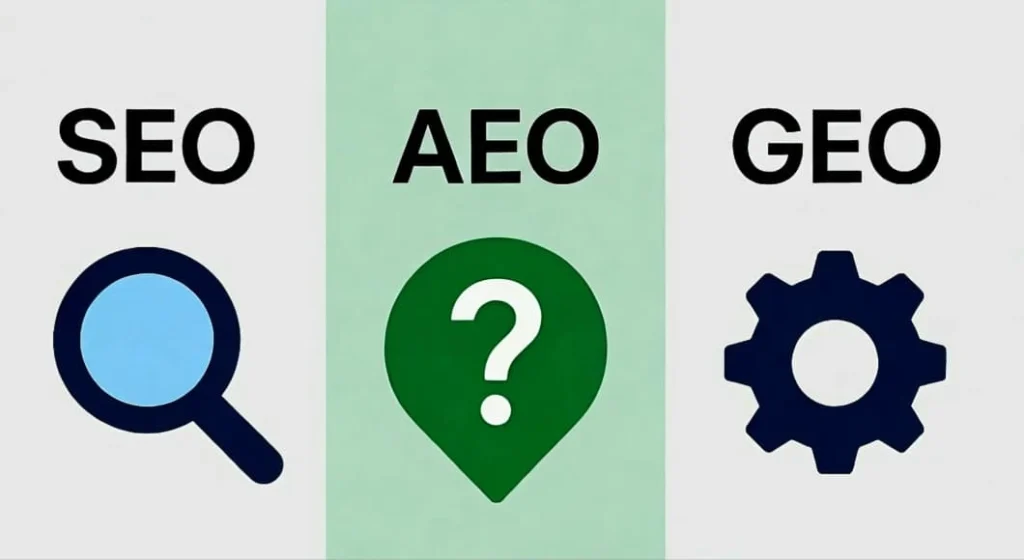
Let me be honest with you. When I first started doing SEO, getting traffic meant one thing — ranking on Google. You stuffed keywords into content, built a few backlinks, and watched the visits roll in. It was almost too simple. Later voice search happened. Then AI chatbots rewrote how people find answers. Then generative AI platforms like ChatGPT, Perplexity, and Google’s own AI Overviews started replacing the traditional search result pages altogether. Suddenly, playing the old game wasn’t enough.
Today, if your digital strategy only accounts for SEO, you’re already behind it. There are two more players at the table — AEO (Answer Engine Optimization) and GEO (Generative Engine Optimization) — and understanding the difference between SEO vs AEO vs GEO isn’t just smart in digital marketing field but it’s all about survival.
So let’s break it all down, properly. First, Let Me Give You a simple idea
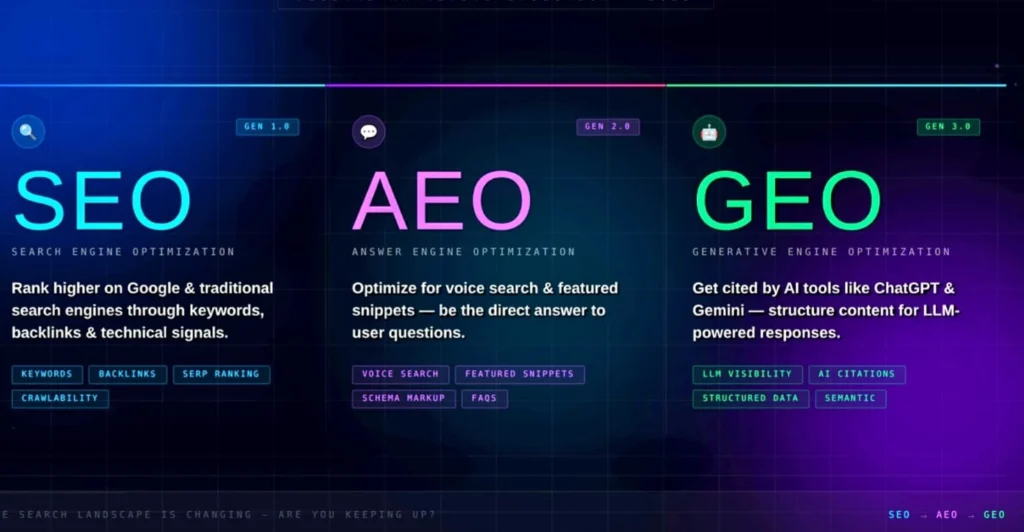
- SEO = Getting found on traditional search engines like Google and Bing through ranked links.
- AEO = Getting your content selected as the direct answer — in featured snippets, voice responses, and AI-powered answer boxes.
- GEO = Getting your brand and content cited inside AI-generated responses from tools like ChatGPT, Perplexity, Gemini etc…
Three disciplines but One shared goal: visibility. But very different strategies to get there.
What Is SEO and Is It Still Relevant?
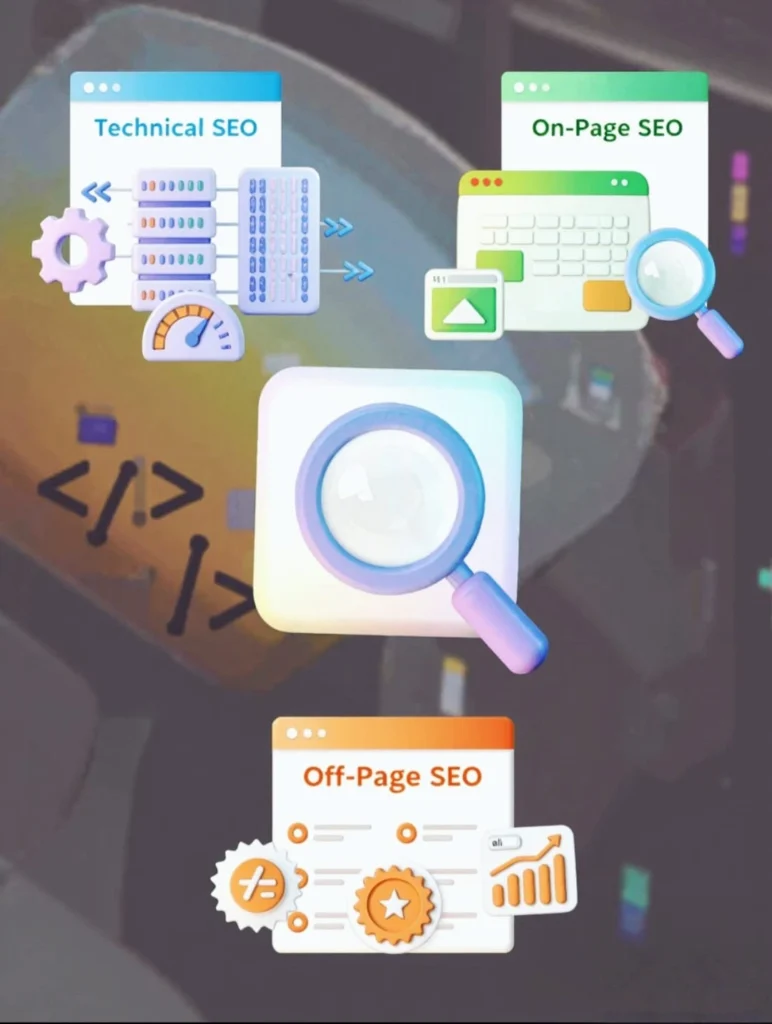
Search Engine Optimization has been around since the late 1990s. And no, it’s not dead. Not even close. But it has grown up considerably. SEO is all about making your website easy for search engines to crawl, understand, and rank it in search engine result page. It involves three broad pillars:
Technical SEO
This is to improve visibility by adjusting on technical side. Site speed, solving loading issues, mobile-friendliness, clean URL structures, proper indexing etc… and it mostly deals by the web developers. If search engines can’t properly crawl your site, then nothing else matters.
On-Page SEO
This is all about inside the page. Keyword research, title, meta descriptions, header(H1s, H2s), internal linking, image alt text, and the overall quality of your written content.
Off-Page SEO
it is happen outside the page to get traffic Mostly backlinks. When other authoritative websites link to yours, Google interprets that as a vote of confidence. The more credible your link profile, the higher your authority score and any outside users can do that
Now here’s what’s shifted in recent years: Google’s algorithm has become far more sophisticated. It no longer just reads keywords — it understands context, intent, and expertise. With its EEAT framework (Experience, Expertise, Authoritativeness, Trustworthiness), Google is evaluating whether you’re the right to be talking about a topic at all. So the days of gaming the system with keyword stuffing? Long gone. Today, SEO rewards material that is actually beneficial, well-organized, deeply researched content published by the credible sources.
Who should still prioritize SEO?
Honestly — everyone with a website. without any doubt i can say that SEO remains the foundation of organic digital visibility. But the problem was it can’t stand alone anymore.
What Is AEO — The Art of Becoming the Answer
Answer Engine Optimization is the younger sibling of SEO, and it’s been quietly becoming one of the most important disciplines in content marketing. AEO focuses on one specific outcome: getting your content chosen as the direct answer to a user’s question.
Think about the last time you Googled something like “how much time should I boil eggs” or “what is the capital of Vietnam.” You probably didn’t click any links. Google showed you the answer right there at the top of the page — that’s a Featured Snippet, and it’s the most classic form of AEO in action.
But it goes further than that. AEO also covers:
- Voice search responses (when Alexa, Siri, or Google Assistant reads out a single answer)
- Knowledge panels (the info boxes on the right side of Google results)
- People Also Ask (PAA) sections
- AI Overviews in Google Search (AI-generated summaries now appearing above the organic results)
The fundamental insight behind AEO is this: users don’t always want a list of links. Sometimes they only need an answer. AEO is about structuring your content so search engines and AI systems can extract and serve that answer directly to users.
How Do You Actually Optimize for AEO?
- Write in clear, concise language. Answers should be direct and understandable.
- Use FAQ sections. Questions formatted as H2 or H3 headers, followed by clear answers, are goldmines for featured snippets.
- Implement schema markup (specifically FAQ schema, HowTo schema, and Speakable schema). This tells search engines exactly what type of content you have.
- Focus on long-tail conversational queries — the kind of questions people actually type or speak, not just keyword phrases.
- Keep your answers between 40–60 words for snippet selection, but back them up with rich content below.
One thing I’ve noticed from my own experience managing content for websites: pages that win featured snippets don’t always have the most backlinks or even the highest domain authority. What they do have is subject clarity. Google and AI systems tend towards the content that is organized, confident, and direct answers to questions without being vague…
What Is GEO — The New horizon of the AI Visibility
This is the one that’s changing the game right now, and honestly most marketers are still sleeping on it. Generative Engine Optimization (GEO) is the practice of optimizing your content to be cited, referred, or paraphrased inside the responses generated by large language models (LLM) lie ChatGPT, Google Gemini, Perplexity AI, Microsoft Copilot etc…
Here’s the problem with the old model: if someone asks ChatGPT “what is the best email marketing tool for small businesses” and your brand isn’t in that response, you just lost a potential customer without ever appearing in any search results. No click, no impression — complete invisibility. That’s the GEO problem.
And it’s happen more common than you think. A growing percentage of users — especially younger audiences are skipping Google search entirely and going straight to AI tools for product research, comparisons, recommendations, and learning. According to multiple studies in recent times, AI chatbot usage for search-like queries has grown dramatically, particularly among 18–36 year old once.
So how does GEO work?
AI language models are trained on large datasets scraped from all over the internet. The content they generate isn’t pulled live from a search engine alone — it’s drawn from patterns in their training data and in some cases, live web browsing capability (like Perplexity and ChatGPT with browsing enabled). For GEO to work in your favor, your content needs to be:
- Authoritative and widely referenced — If respected sites, publications or forums mention your brand or content, there’s a higher chance AI models have absorbed that reputation into their training data.
- Clear, factual, and structured — AI models prefer content that is easy to parse. Dense, jargon-heavy writing is harder to extract clean data from. Write like you’re explaining to a friend or student, not a expert committee.
- Present on platforms AI tools browse — Perplexity, for example, crawls live web pages. Being indexed, accessible, and fast helps. Make sure your robots.txt isn’t carelessly blocking AI crawlers.
- Citation-worthy — Create content that others want to link to and reference. Original data, research, case studies, unique frameworks — these get cited by humans, which in turn feeds AI models.
- Consistent across the web — Your brand should appear consistently across your website, LinkedIn, guest posts, podcasts, interviews, industry directories, and social media. AI models build a composite picture of your authority from multiple signals.
One strategy I particularly like is writing “definition posts” — content that clearly and definitively explains a concept within your niche. These types of posts get quoted and referenced constantly, both by humans and AI systems.
How Do These Three Work Together?
Here’s where I want to push back against a common misunderstanding: these three are not competing strategies. They’re layered.
Just think of it like a house:
SEO is the foundation — without it, your website doesn’t exist in the digital ecosystem.
AEO is the front door — it’s how people find quick, direct answers and first impressions of your brand.
GEO is the reputation — it’s what AI systems say about you when someone asks, and it’s increasingly the deciding factor in whether you get discovered at all.
A well-rounded content strategy needs to serve all three. The good news? A lot of the best practices overlap. High-quality, well-structured, authoritative content tends to perform well for all three disciplines simultaneously. For example, a detailed blog post that:
- Targets a specific long-tail keyword (SEO)
- Includes a clear FAQ section with schema markup (AEO)
- Presents original insights and is published on a credible, widely-cited domain (GEO)
all these doing triple duty. That’s the advantage.
Practical Action Plan: Where to Start
If you’re setting up or auditing your digital strategy today, here’s how I’d prioritize:
Step 1 — Fix your SEO foundation first. Audit your site’s technical health. Fix broken links, improve page speed, make sure you’re indexed properly. Then make sure your on-page content is structured around genuine search intent.
Step 2 — Layer AEO on top. Go through your existing content and identify pages that rank for question-based queries. Restructure those pages with clear Q&A sections. Add FAQ schema where it’s applicable.
Step 3 — Start building for GEO now. Don’t wait for this one. Start creating reference-worthy content — original data, strong opinion pieces, how-to frameworks unique to your brand. Build your presence consistently across the web so AI tools have multiple signals to pull from.
Key takeaway (SEO vs AEO vs GEO)
The landscape of digital visibility has fundamentally changed. Your audience isn’t just typing keywords into Google and clicking links anymore. They’re asking AI chatbots questions. They’re listening to voice assistants. They’re consuming AI-curated summaries before they ever see a traditional search result.
SEO keeps you visible in the old game. AEO keeps you visible at the point of direct answers. GEO keeps you visible in the AI-powered future that’s already here.
Master all three, and you’re not just keeping up — you’re ahead of the curve.
If this helped you get a clearer picture of where your digital strategy needs to go, drop a comment below or share this post with someone still stuck in old SEO mode. They need this more than they know. also you can visit my page. Thankyou.
Good. Someone like me who diving into digital marketing field this help me to get good informations regarding aeo and geo.
@vindhuja, Thankyou for the feedback
Excellent blog! clear comparison of SEO, AEO, and GEO is truly insightful. Thanqu for the valuable insights!
@Farseena, great to hear. Thanks for reading
Good job!! Informative blog . Great breakdown of the topic
@Sanfer, Thanks for reading. I’m delighted this post provided you value.
Insightful 💡
@Muhammed khais, Thanks for your feedback 🙌