
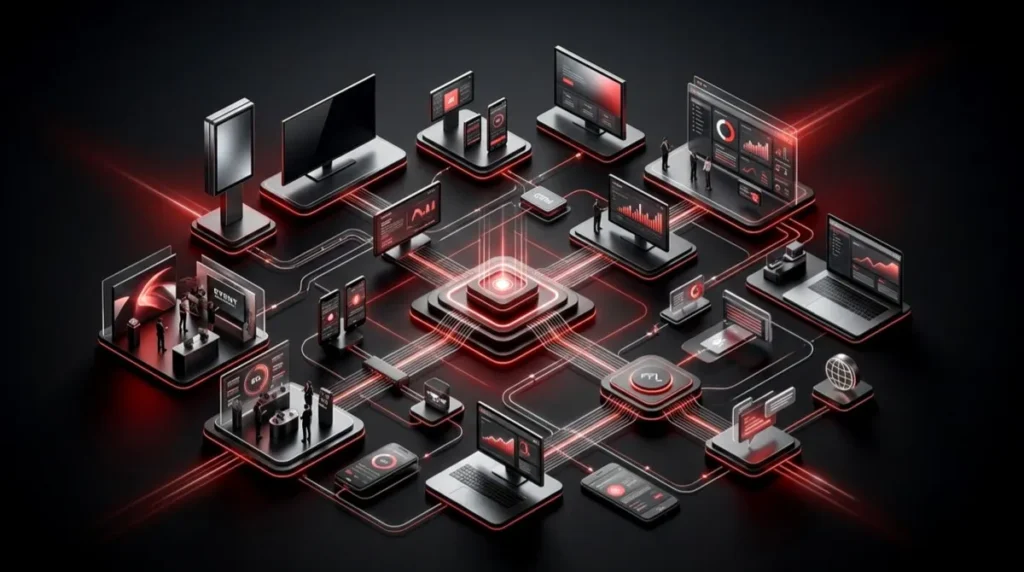
There’s a question I get asked a lot by business owners and junior marketers alike: Should we run a TV ad or focus on Instagram? Should we do a ground activation or push digital campaigns?
My answer is always the same – why are you choosing one when the real power lies in combining all of them?
That choice, or rather the refusal to make it, is the entire foundation of integrated marketing. And yet, most brands still don’t practice it. Not because they don’t believe in the idea, but because they have a coordination problem.
The creative team runs a brilliant television campaign. The digital team is busy A/B testing Facebook ads. The on-ground team is managing retailer activations and sampling drives. And all three are doing their jobs well — except for one small, costly detail: none of them are actually talking to each other.
The consumer, meanwhile, sees three different versions of the same brand in the same week. A polished, emotionally charged television ad on Sunday. A flat, purely promotional social media post on Tuesday. A product demo at a mall kiosk on Saturday that looks like it belongs to an entirely different company.
That disconnect isn’t just an aesthetic problem. It quietly erodes trust. And trust, once eroded, is expensive to rebuild.
This is exactly why integrated marketing strategy exists – not as a buzzword, but as a genuine operational philosophy. When every channel, message, and medium pulls in the same direction, the combined effect vastly outperforms the sum of its individual parts.
Research consistently shows that coordinated campaigns running across multiple channels dramatically outperform those confined to just one or two. The math of integration almost always works in a brand’s favor.
So let’s break down the ecosystem – ATL, BTL, TTL, and digital – and understand not just what each one means, but how they function together as a single, unified machine.
A Brief Origin Story Worth Knowing

Before diving into strategy, it helps to understand where these three terms actually came from – because the origin tells us a great deal about how they were always meant to function.
The distinction between Above-the-Line and Below-the-Line marketing didn’t emerge from a marketing theory textbook. It came from an accounting practice, widely attributed to Procter & Gamble, where mass media advertising expenses were recorded in the upper section of a financial ledger – above a literal horizontal line – while expenses for direct promotional activities like coupons, sampling, and retail contests were written below it.
What started as a bookkeeping convention became the organizing framework of an entire industry. And Through-the-Line emerged later as a practical response to digital media blurring that original distinction beyond recognition. A YouTube pre-roll ad, for instance, reaches a mass audience like traditional ATL but can be hyper-targeted to a very specific demographic – which is classically BTL behavior. The lines blurred. TTL became the honest acknowledgement of that blurring.
Understanding this history matters because it reveals something important: ATL, BTL, and TTL were never meant to be three competing strategies. They were always describing different points along the same spectrum of brand communication.
ATL — Building the Brand in the Public Eye

Above-the-Line marketing is mass communication. Television commercials, national radio campaigns, print spreads in major publications, large-format outdoor advertising, and cinema are all ATL channels. Their defining characteristic is reach. They speak to everyone and no one simultaneously – the message isn’t customized for any individual; it’s crafted to resonate with an entire culture at once.
What ATL achieves, when executed with genuine creative intelligence, is something no algorithm or retargeting strategy can manufacture on its own – shared awareness. It plants a flag in the public consciousness. It announces, at scale, that a brand exists, what it stands for, and why it deserves a place in people’s lives.
Think about the campaigns that have embedded themselves into everyday cultural conversation. The Fevicol ads that transformed a mundane adhesive brand into a beloved institution through sheer wit and storytelling craft. Apple’s decades-long narrative around human creativity. These weren’t product announcements – they were character-building exercises for a brand, delivered to millions simultaneously.
There is a psychological layer worth acknowledging here. When consumers encounter a brand on a massive billboard or during prime-time television, the scale of that presence communicates something beyond the message itself. It signals investment and commitment. Consumers, consciously or not, factor this signal into how they form brand opinions. Being seen in big places makes a brand feel like a brand worth trusting.
The known limitations of ATL are just as important to understand: it is expensive, largely untargeted, and difficult to attribute in terms of direct commercial return. You cannot easily trace a single purchase back to a billboard. But this is not a design flaw – it’s a design characteristic. ATL is built to operate at the awareness end of the funnel, where the goal is impression-building, not immediate conversion.
Where ATL works best:
- Establishing or refreshing a brand identity across a broad, diverse market
- Launching a product that requires rapid, widespread awareness
- Reinforcing brand presence during high-competition windows like festive seasons or new market entries
- Building the long-term brand equity that keeps a company resilient through difficult commercial periods
BTL — Where the Brand Gets Specific

Below-the-Line marketing operates at the opposite end of the intent spectrum, and does so with deliberate precision. Rather than speaking to everyone, BTL speaks to someone a defined group, in a particular context, with a message shaped around their specific behavior, need, or location.
The toolkit here is wide: product sampling, in-store activations, event-based promotions, direct mail, email marketing, influencer partnerships, trade fair participation, roadshows, point-of-sale merchandising, loyalty programmes, and performance-driven digital advertising. What connects all of these activities is the degree to which they can be planned, targeted, and critically measured.
This accountability is BTL’s greatest operational advantage. Every investment can be evaluated against a clear outcome. Did the sampling activation drive trial uptake in that specific territory? Did the personalised email campaign convert the intended segment? Did the in-store display shift the promoted product in that particular store chain? BTL gives you answers that ATL, by nature, cannot.
There’s a deeper insight here that tends to be underappreciated: BTL is the mechanism through which a brand moves from being known to being chosen. ATL builds the stage. BTL closes the gap between recognition and decision.
A well-executed BTL campaign also achieves something emotionally powerful – it makes a consumer feel seen. When a brand reaches out with an offer that connects with your recent purchase behavior, or shows up at an event that genuinely matters to your community, the interaction stops feeling like advertising and starts feeling like conversation. That shift in perception is where the real conversion advantage of BTL lives.
Where BTL works best:
- Driving trial for new products with a clearly defined target segment
- Converting consideration into purchase through timely, personalized communication
- Building direct consumer relationships that compound into long-term loyalty
- Generating measurable ROI that holds up to stakeholder scrutiny
TTL — The Strategy That Refuses to Choose
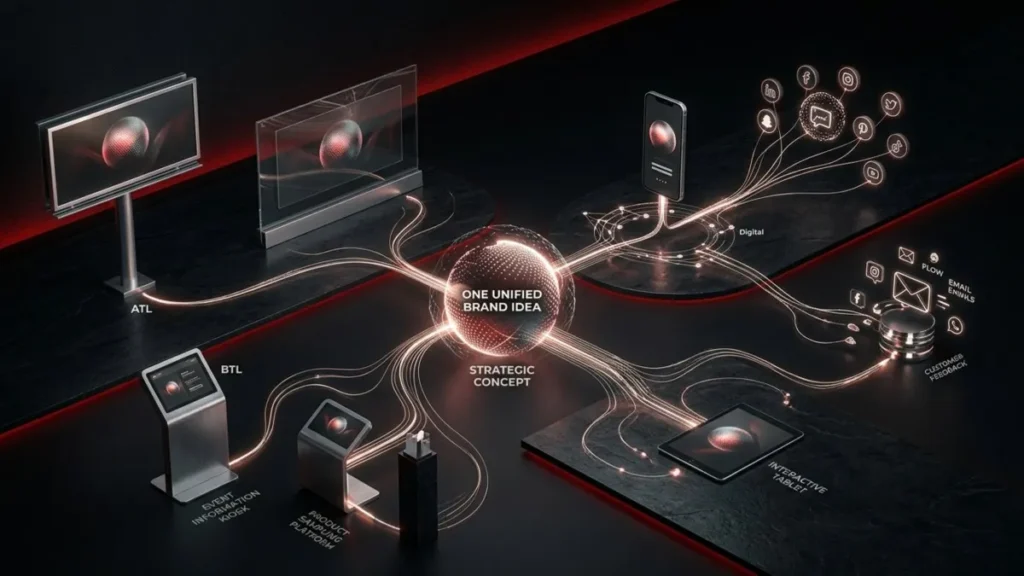
Through-the-Line marketing isn’t a compromise between ATL and BTL. It’s the recognition that the most effective campaigns don’t draw that boundary at all.
TTL thinking starts with a single, powerful brand idea – one creative territory, one emotional truth, one strategic message – and then asks: how does this idea translate coherently across every channel and touchpoint available to us?
The answer to that question is a TTL campaign.
The big television idea becomes the visual language for social media content. The emotional narrative from the TV ad sets the tone for the in-store activation. The digital retargeting effort reinforces what the billboard planted. The on-ground experience amplifies what the radio spot promised. Everything loops back to the same origin point, creating a consumer experience where each channel’s contribution reinforces every other channel’s work.
This is also why scholars studying Integrated Marketing Communications find that message consistency across touchpoints is one of the strongest predictors of customer satisfaction and brand loyalty. When a consumer’s encounter with a brand feels coherent – whether it happens on television, at a kiosk, in an inbox, or on a social feed – their confidence in that brand deepens in ways that fragmented communication simply cannot produce.
Consider what a well-orchestrated TTL campaign actually looks like in motion: A brand launches a new product with a television commercial built around a lifestyle aspiration. The commercial ends with a hashtag and a QR code. Consumers who scan the code reach an interactive digital experience. Those who engage online receive a personalized follow-up offer. Meanwhile, field teams in key cities bring the same campaign idea to life through physical interaction and sampling. Every activation feels like the same brand, in the same conversation, moving the same person forward along their decision journey.
Where TTL works best:
- Major product launches requiring simultaneous mass reach and personal engagement
- Competitive categories where brands must be both highly visible and highly persuasive
- Organizations with the budget and internal coordination capacity to execute across channels
- Campaigns designed to sustain brand presence over an extended period with compounding effect
Digital — Not a Channel. A Central Nervous System.

Here is the shift in perspective that separates marketers who truly understand integrated strategy from those still operating on older frameworks: digital is not a standalone marketing channel. It is the infrastructure through which ATL, BTL, and TTL become genuinely integrated.
Digital is the connective layer that allows every element of a marketing ecosystem to speak to every other element.
It is how an emotionally resonant television commercial extends its active life by days or weeks through organic social sharing, user commentary, and influencer amplification. It is how a BTL sampling event in one city reaches audiences who were never physically present, through Stories, Reels, and video recaps. It is how a brand takes behavioral intelligence generated by its BTL performance campaigns and uses that insight to sharpen the creative brief for its next ATL production. It is how a QR code printed on a highway billboard transforms a passive outdoor impression into a measurable, interactive brand experience.
Without digital as this connective layer, ATL, BTL, and TTL remain islands. With it, they become an ecosystem where each investment multiplies the returns from every other investment.
Within an integrated marketing framework, digital performs four distinct and irreplaceable functions:
Amplification– A strong ATL campaign now has a second life through digital. When a television commercial genuinely moves people, they share it, react to it, and argue about it on social platforms. That earned attention is not random – it is the outcome of a creative idea powerful enough to travel beyond its paid placement. Brands that understand this design their ATL creative with organic shareability built in from the first brief.
Personalization– Digital channels enable a degree of individual relevance that would have been operationally impossible in previous eras of marketing. A consumer who watched a product video can receive a contextually appropriate follow-up message within hours. Someone who spent time on a pricing page can be shown a relevant comparison communication during their commute. Consumers consistently prefer communication that feels relevant to their actual situation – and digital makes that relevance achievable at scale.
Measurement and Attribution– One of the enduring challenges of ATL has been demonstrating its contribution to hard business outcomes. Digital changes this equation, imperfectly but meaningfully. Spikes in branded search queries immediately after a television ad airs. Direct website traffic increases following an outdoor campaign launch in a new geography. Lift in social sentiment across a campaign window. These digital signals allow marketers to build a far more complete picture of cross-channel impact, making the case for integrated investment considerably more defensible in business conversations.
Community Building– The most undervalued function of digital within integrated marketing is its capacity to cultivate genuine communities – groups of loyal, engaged customers who become advocates, content creators, and amplifiers for every future campaign. A brand with an authentic, active community doesn’t just get better returns from its BTL campaigns. It gets better returns from everything it does, because every new initiative lands on a foundation of pre-existing warmth and trust.
How to Build Integration from the Ground Up
The theory is important. But application is everything. Here is how to actually approach an integrated campaign:
Lead with one idea, not a channel plan : The most consistent mistake in marketing planning is deciding which channels to use before deciding what the brand needs to say. Start with the human insight, the brand truth, the story that is genuinely worth telling. Once you have that clearly articulated, the channels become obvious because each has its own natural way of expressing the same idea in its own language.
Map the full consumer journey before producing anything : Before a single frame of video is shot, before a single email template is designed, map out the complete path a consumer travels from not knowing your brand to actively recommending it. Where does awareness begin? What triggers genuine consideration? What friction exists between interest and purchase? What experience turns a one-time buyer into a repeat customer? Place your ATL, BTL, digital, and TTL activities at the relevant points along that map, each serving the role appropriate to that stage.
Let intelligence flow in loops, not lines : The insight gathered from a BTL activation — what questions consumers asked, which product variant generated the strongest response, what language worked in face-to-face conversation — should travel back to the digital team and inform the next targeting strategy, and back to the creative team to inform the next ATL brief. Marketing intelligence that circulates across the whole system makes every subsequent campaign sharper.
Audit consistency throughout, not just at the start : At regular intervals across a campaign’s lifecycle, hold every active communication against the original brand idea. It is surprisingly easy for a campaign to drift as different agencies and internal teams make individually reasonable adjustments that collectively add up to incoherence. Drift is the quiet enemy of integration — and vigilance is the only reliable defense.
The Real Point
Marketing that works is marketing experienced as a single, coherent conversation – regardless of how many channels it happens to travel across.
ATL creates the dream. It builds the world the brand inhabits and makes that world feel worth entering. BTL makes the brand tangible, personal, and actionable. TTL holds these together under one idea, one voice, one overarching strategy. And digital connects every part of the system so that each investment compounds the returns of every other.
The brands that build lasting market presence are not those with the deepest pockets in any single channel. They are the ones who have figured out how to make every channel reinforce every other channel – so that the consumer, wherever they happen to meet the brand next, recognizes it immediately as the same brand they’ve met before.
Integration is not a production technique. It is a way of thinking about what marketing is actually for. And once you build with that thinking, the difference in impact is not subtle at all.
Have questions about building an integrated marketing strategy for your business? Drop them in the comments – this is exactly the kind of challenge worth thinking through properly.
This is super helpful to understand about different marketing channels. Thankyou.
Do small businesses need integrated marketing?
Thankyou for asking @ainma, Yes even small business need that but not in a large-scale or expensive way.
Integrated marketing for a small business does not mean running TV ads, events, and digital campaigns all at once.
It simply means making sure the brand message, customer experience, and communication stay connected across the channels the business is already using.
Even if a business is only active on Instagram, WhatsApp, Google, and local offline promotion, integration still matters.
The principle is the same: clarity, consistency, and connected customer experience.
Is integrated marketing and omnichannel marketing same?
@farseena, good question. They are related, but not exactly the same.
Integrated marketing focuses on making sure brand communication, messaging, and strategy stay aligned across channels.
Omnichannel marketing focuses more on creating a seamless customer experience across touchpoints.
In simple terms:
Integrated marketing is about communication consistency
Omnichannel is about experience continuity
The strongest brands usually combine both. tnx for asking!
Where should someone start if they want to understand integrated marketing better?
A better place to start is not with the channels themselves.
Start with how people actually discover, trust, and choose a brand. Ask simple things like:
Where do people first notice a brand?
What makes them take it seriously?
What helps them move closer to a decision?
And where do they usually get confused or drop off?
Once you understand that part, ATL, BTL, TTL, and digital channels start making a lot more sense.
Because then you’re not just learning marketing terms.
You’re understanding how all communication works together around real customer behaviour
Hope you got your answer.tnx for asking🤝 @muhasina