
You check your analytics. Website traffic is coming in. Your SEO efforts are bringing visitors, your Google Ads are generating clicks, and your social media campaigns are sending people to your website.
But something is missing.
The enquiry form receives very few submissions. Nobody seems to be using the contact button. Sales opportunities remain limited, even though the website appears to be getting attention.
Naturally, the first thought is often, “We need more traffic.”
But do you?
A website can have a traffic problem, a conversion problem, a targeting problem, or a measurement problem. Treating all four as a traffic problem can lead to unnecessary spending and missed opportunities.
Before investing more money in advertising or trying to improve search rankings, it is worth understanding what happens after someone visits your website.
In this guide, we’ll examine seven possible reasons visitors don’t become leads, how to investigate them using analytics, and how to decide which problem deserves attention first.
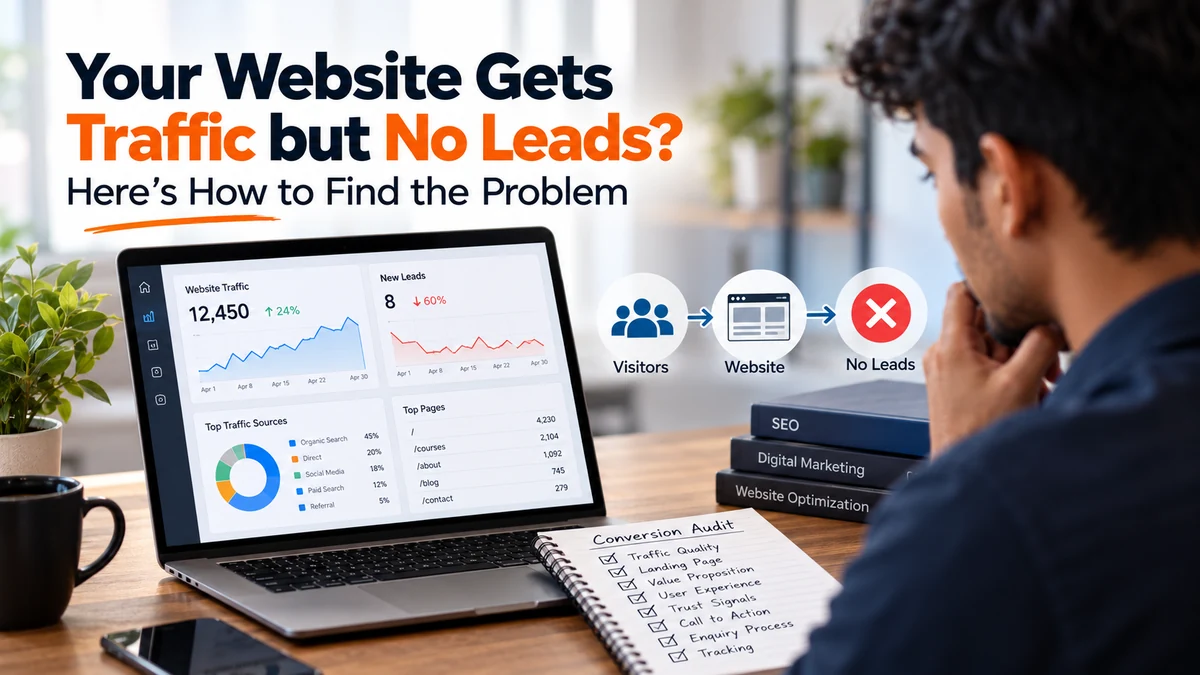
1. First, Understand the Difference Between Traffic and Conversions
Website traffic tells you that people are reaching your website. Conversions tell you whether they are taking an action that matters to your business.
Those actions depend on what the website is designed to achieve.
For a training institute, a conversion might be a course enquiry. For a real estate business, it could be a property viewing request. For a software company, it might be a demo booking.
The first step is to define what a valuable conversion actually means for your business.
Consider this hypothetical example.
A training institute receives 2,000 website visits in one month but generates only 20 enquiries.
Its enquiry conversion rate is:
20 ÷ 2,000 × 100 = 1%
That tells us that 1% of the recorded visits resulted in enquiries, assuming the traffic and conversion measurements are accurate.
Is 1% good or bad?
We cannot answer that from the number alone. We would need to understand the institute’s courses, traffic sources, audience, offer, location, and historical performance.
However, the calculation gives us something useful: a starting point for investigation.
Instead of immediately trying to double website traffic, the business can examine why the remaining visitors aren’t enquiring.
The objective isn’t to force every visitor to convert. Many people will be researching, comparing options, or simply looking for information.
The objective is to identify and remove unnecessary obstacles for people who genuinely need the service.
2. Problem One: You’re Attracting the Wrong Audience
Not all website traffic has the same commercial value.
Imagine that a company offers professional digital marketing services to businesses. Its website receives visitors searching for free marketing courses, definitions of marketing terminology, and entry-level career opportunities.
The traffic may be relevant to marketing as a subject, but most of those visitors are not necessarily looking for a service provider.
This creates a mismatch between what attracts visitors and what the business sells.
The same issue can occur with paid advertising. An advertisement may receive plenty of clicks because the message is interesting, but the people clicking might not have the budget, location, requirements, or intention to become customers.
How to investigate
Start by examining your traffic sources and the pages visitors enter through.
For organic search traffic, Google Search Console can help you investigate search queries, impressions, clicks, and landing pages.
For website behaviour, Google Analytics 4 can help you examine traffic acquisition, landing-page activity, and tracked conversions.
For paid campaigns, compare the targeting and messaging with the actual enquiries received.
Ask yourself:
- Are visitors searching for information or actively looking for a solution?
- Does the landing page match the promise made in the advertisement?
- Are visitors coming from locations the business can serve?
- Do the enquiries meet the intended customer’s basic requirements?
If the problem is audience relevance, increasing the traffic budget may simply increase the number of unsuitable visitors.
The better question is not how to attract more people. It is how to attract more of the right people.
3. Problem Two: Your Website Doesn’t Explain the Value Quickly Enough
Visitors should not have to investigate several pages to understand what your business does, whom it serves, or why they should consider it.
Suppose someone lands on a website offering a professional course. The headline reads:
“Empowering Tomorrow’s Leaders Through Excellence.”
It sounds positive, but it doesn’t tell the visitor which course is offered, who should enrol, what skills they will develop, or what action they should take next.
Compare that with a more specific message:
“Learn Practical Digital Marketing Skills Through Hands-On Campaign Projects.”
The second statement communicates the subject and the practical focus more clearly, assuming the course genuinely delivers that experience.
The principle applies across industries. A real estate website should make relevant property information easy to find. A service business should clearly explain its offer. An e-commerce product page should help customers understand what they are buying.
How to investigate
Open your main landing page and look at it as a first-time visitor.
Within the first few seconds, can someone understand:
- What the business offers?
- Who the offer is intended for?
- Why it might be useful to them?
- What they should do next?
Look at your headline, supporting copy, imagery, and primary call to action.
Avoid vague statements that could describe almost any competitor. Use specific, accurate information that helps visitors decide whether the offer fits their needs.
You do not need to rewrite the entire website immediately. Sometimes, improving the clarity of one important landing page is a more useful starting point.
4. Problem Three: Your Landing Page Creates Too Much Friction
A visitor can be genuinely interested and still abandon the enquiry process.
Perhaps the page loads slowly on their phone. Maybe the contact button is difficult to find. Perhaps the form asks for information the business doesn’t need at that stage.
These details can turn a simple action into an unnecessary task.
Consider two enquiry forms.
The first asks for a name, phone number, email address, budget, company size, industry, job title, location, preferred communication method, and a detailed description of the requirement.
The second asks for a name, one contact method, and a short message.
Neither form is automatically better in every situation. A complex business-to-business enquiry may require more qualifying information than a simple appointment request.
The important question is whether every required field helps the business or the customer enough to justify the extra effort.
How to investigate
Test your website on an actual mobile phone, not only on a desktop computer.
Complete the enquiry form yourself. Tap every important button. Check whether the page behaves as expected and whether confirmation messages appear after submission.
Review the following:
- Are the primary buttons easy to identify?
- Does the form work correctly on mobile?
- Are any fields unnecessarily difficult to complete?
- Does the page explain what happens after submission?
- Are there broken links, validation errors, or confusing messages?
If analytics shows that users reach an enquiry page but rarely complete the process, investigate the form and surrounding experience.
However, don’t assume that every drop-off represents frustration. Some visitors simply decide that the offer isn’t suitable.
Use the evidence to determine where improvements are justified.
5. Problem Four: Visitors Don’t Have Enough Reason to Trust You
Asking someone to submit their contact details is asking them to take a small risk.
They may wonder whether the business is legitimate, whether the service will meet expectations, or whether they will be contacted repeatedly after submitting the form.
A website that provides little evidence of credibility leaves those questions unanswered.
Trust is particularly important when customers are making expensive, complicated, or personally significant decisions.
A potential student may want to understand the quality of an educational programme. A property buyer may look for clear details about the property and the people handling the transaction. A business evaluating an agency may want evidence that the agency understands its requirements.
What can improve trust?
The right evidence depends on the business.
Useful elements may include:
- Genuine customer testimonials, published with appropriate permission.
- Relevant qualifications, credentials, or professional experience.
- Clear information about the business and the people behind it.
- Specific explanations of the service or product.
- Transparent pricing or an honest explanation of how pricing works.
- Accurate contact information and clear privacy practices.
- Real examples of work, supported by verifiable details.
Avoid fabricated reviews, misleading claims, and unsupported promises.
A collection of impressive-looking graphics cannot replace credible evidence.
Trust isn’t created by telling visitors that your business is trustworthy. It is built by giving them good reasons to believe you.
6. Problem Five: Your Call to Action Isn’t Clear
A call to action tells visitors what they can do next.
Yet many websites present several competing options without making any of them particularly clear.
The visitor might see “Contact Us,” “Explore More,” “Discover Our Story,” “Learn More,” and “Get Started” scattered across the same section.
These phrases are not inherently bad. The problem arises when they do not reflect the visitor’s needs or make the next step obvious.
A business selling a high-consideration service may need to explain what happens after a consultation request. A course provider may need to make course information or an enquiry option easy to access.
Match the action to the visitor’s intent
Consider the difference between these examples:
| Visitor’s need | Potential call to action |
|---|---|
| Wants course information | View Course Details |
| Has questions about a course | Enquire About This Course |
| Wants to speak with a service provider | Book a Consultation |
| Wants to view an available property | Request a Viewing |
| Is ready to make a purchase | Buy Now |
These are examples, not universal prescriptions.
The right wording depends on the offer, the visitor’s stage in the decision process, and the action your business wants them to take.
Make the primary action visually distinct, explain what happens next, and avoid promising an outcome you cannot guarantee.
Then measure whether the change improves meaningful conversions.
7. Problem Six: You’re Measuring Activity Instead of the Actual Customer Journey
This is where analytics becomes particularly useful.
A website owner might know that 5,000 visitors arrived last month but have no reliable information about how many clicked the enquiry button, completed the form, or became qualified leads.
Without those measurements, diagnosing poor performance becomes guesswork.
Think of the journey as a series of steps:
Traffic source → Landing page → Meaningful interaction → Enquiry submission → Qualified lead → Customer
A problem at one stage may require a different solution from a problem at another.
For example:
- If relevant users aren’t reaching the landing page, investigate traffic acquisition.
- If visitors arrive but don’t engage, examine page relevance and usability.
- If visitors click the enquiry button but don’t submit the form, investigate the enquiry process.
- If forms generate enquiries but few become qualified leads, examine targeting, expectations, and qualification criteria.
- If qualified leads don’t become customers, the issue may involve pricing, follow-up, sales conversations, or the offer itself.
These are possible explanations, not automatic conclusions. A business should use its actual data to test them.
A practical measurement setup
Google Analytics 4 can help track key website interactions and conversions when the appropriate measurement is configured.
For example, a business might track successful enquiry submissions as a conversion event. It could then compare performance across landing pages and traffic sources.
Google Search Console can provide complementary information about organic search visibility and clicks.
For paid campaigns, advertising-platform reports can show campaign performance, but the business should also connect those results with actual lead and sales data where possible.
One important detail: a click on a button is not the same thing as a successful enquiry.
Where possible, track the completed action rather than relying exclusively on button clicks. Verify that the tracking works and that duplicate events are not inflating the numbers.
For more on interpreting marketing data and selecting meaningful KPIs, see my guide to Data-Driven Marketing: How to Measure What Actually Matters.
8. Problem Seven: You’re Fixing Symptoms Instead of Finding the Cause
Suppose a landing page receives relevant traffic but generates few enquiries.
A redesign might help. A new headline might help. A different advertisement might help.
But choosing one without investigating the evidence is little more than guessing.
A better approach is to develop a hypothesis and test it.
For example:
Observation: Visitors from a specific paid campaign arrive at the landing page, but relatively few submit the enquiry form.
Hypothesis: The advertisement may be attracting people whose expectations do not match the offer described on the landing page.
Investigation: Compare the advertisement’s promise with the landing-page content. Review the search terms or audience characteristics where available, and examine the enquiries actually received.
Action: If the evidence supports a mismatch, adjust the targeting or message so the advertisement and landing page communicate the same offer.
Evaluation: Compare the results after the change, accounting for traffic volume, lead quality, and other factors that could influence performance.
This process is more useful than changing several things simultaneously and hoping the numbers improve.
When practical, test one important change at a time. If traffic volume is low, allow sufficient time to collect meaningful evidence before drawing conclusions.
Not every improvement requires a formal A/B test. Some problems, such as a broken form or an inaccurate headline, can be corrected directly. Testing is particularly useful when multiple plausible solutions exist and the better choice is uncertain.
9. A Practical Website Conversion Audit
Before increasing advertising spend or launching another campaign, use this checklist to identify the most important issues.
| Audit area | What to check | Evidence to look for |
|---|---|---|
| Traffic quality | Are visitors relevant to the offer? | Search queries, campaign targeting, traffic-source data |
| Landing-page relevance | Does the page match the visitor’s expectations? | Advertisement copy, search intent, landing-page content |
| Value proposition | Is the offer easy to understand? | Headline, supporting text, product or service details |
| User experience | Can visitors navigate and act easily? | Mobile usability, loading issues, navigation |
| Trust | Is there credible evidence supporting the offer? | Genuine testimonials, credentials, accurate business information |
| Call to action | Is the next step clear? | Button wording, placement, relevance |
| Enquiry process | Can visitors complete the intended action? | Form testing, errors, successful submissions |
| Tracking | Are important conversions recorded accurately? | Test submissions, event configuration, analytics reports |
| Lead quality | Are enquiries commercially relevant? | Qualification records, CRM data, sales feedback |
You do not need to work through every item with equal urgency.
Start with the issues that could invalidate your measurements or prevent interested visitors from enquiring. Then investigate the areas where your data shows the greatest potential for improvement.
This makes the audit a decision-making tool rather than just another checklist.
10. Should You Improve Conversions or Invest in More Traffic?
The answer depends on the evidence.
If your website already converts relevant visitors into valuable leads efficiently, increasing qualified traffic may be a reasonable next step.
If visitors are struggling to understand the offer or complete the enquiry process, improving those areas may be a better priority.
If your traffic is irrelevant, improving the quality of that traffic should come before trying to increase its volume.
And if tracking is unreliable, fix the measurement problem before drawing strong conclusions from the reported numbers.
Let’s return to our hypothetical training institute.
It receives 2,000 visits and generates 20 enquiries, producing a measured enquiry conversion rate of 1%.
Suppose the institute improves its landing page and later receives 30 enquiries from 2,000 visits.
The new measured rate is 1.5%.
That would represent a 50% relative increase in conversion rate, from 1% to 1.5%, and ten additional enquiries at the same traffic volume.
But the example does not establish that a specific change will deliver those results. It simply illustrates why improving the outcome of existing traffic can be worth investigating.
The institute would still need to determine whether the extra enquiries are qualified, whether the improvement is sustained, and whether other factors influenced the result.
Ultimately, more enquiries matter only when they contribute to the business objective.
Final Thoughts: Diagnose Before You Spend More
When a website gets traffic but generates few leads, the instinct to attract more visitors is understandable.
Traffic is visible. Campaign spending is measurable. Search rankings are easy to discuss.
But the path from a website visit to a business result involves several decisions made by the visitor—and several opportunities for a business to make that journey clearer.
The audience might be wrong. The message might be vague. The offer might lack credibility. The enquiry process might be unnecessarily difficult. Or the business might simply be measuring the wrong thing.
You cannot identify the right solution by looking at traffic volume alone.
Start with the business goal. Define the conversion that matters. Check whether your measurement is reliable. Follow the customer journey, identify where relevant visitors are dropping off, and investigate the likely cause before making changes.
Then prioritise improvements, measure the results, and learn from the evidence.
You may discover that your website genuinely needs more qualified traffic. You may also discover that the opportunity lies in making better use of the visitors you already have.
More traffic is not automatically the answer. The better answer is understanding what prevents the right visitors from taking the next step.
Frequently Asked Questions
Why is my website getting traffic but no leads?
Possible reasons include irrelevant traffic, unclear messaging, weak trust signals, a confusing user experience, an ineffective call to action, or a broken enquiry process. Inaccurate conversion tracking can also hide real performance. Examine the data before deciding which explanation fits your website.
How do I turn website traffic into leads?
Start by identifying the audience you want to reach and the action you want visitors to take. Make the offer clear, match landing-page content to visitor expectations, reduce unnecessary friction, provide credible evidence, and measure successful enquiries.
How can I check whether my website is converting visitors?
Define a conversion, such as a successfully submitted enquiry form. Use an appropriately configured analytics tool to measure completed actions relative to the relevant traffic. Verify the tracking and evaluate lead quality alongside conversion volume.
Should I run more Google Ads if my website isn’t generating leads?
Not automatically. First, investigate traffic relevance, landing-page performance, the enquiry process, and conversion tracking. If the website and measurement are working well but qualified traffic is insufficient, additional advertising may be worth evaluating.
What is a good website conversion rate?
There is no single rate that is appropriate for every website. The result depends on the industry, offer, visitor intent, traffic source, conversion definition, and buying process. Compare your own performance over time and use relevant benchmarks only when their context matches yours.